

Submitted by Rev. Dr. Scott Meador, lead pastor for Cedar Rapids Lovely Lane United Methodist Church
In the early 1960’s a new Methodist church was forming on the northwest edge of Cedar Rapids, Iowa. When it looked like this fledgling congregation had staying power, a name was needed. After considering several good possibilities, including some tied to the local neighborhood and area, they chose “Lovely Lane.” The name was a nod to the Mother Church of American Methodism in Baltimore, Maryland, and the site of the Christmas Conference in 1784 that brought the Methodist Episcopal Church into existence. Over the years, the Cedar Rapids congregation has been very proud of this historical connection.
I recently had the opportunity and privilege to visit the Lovely Lane United Methodist Church in Baltimore. As lead pastor of the church in Iowa, it was wonderful to connect with this church in Maryland. Upon arriving on the site in a pleasant area north of downtown Baltimore, I was immediately impressed with the Romanesque stone building with the large tower reaching into the sky. I quickly learned this was the fifth Lovely Lane site. The Christmas Conference did not take place on this exact site. The cornerstone for this current site was laid in 1884, the centennial year of the Christmas Conference, and it was completed in 1887.
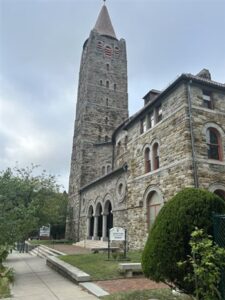
Lovely Lane United Methodist Church in Baltimore, Maryland. Photo courtesy of Scott Meador.
Moving inside the building, I began a tour in the Lovely Lane Museum and Archives area. My guide was the Rev. Dr. Bonnie McCubbin, the Director of Museums and Pilgrimage/Conference Archivist for the Baltimore-Washington Conference. This area was tremendous, and Bonnie was a super guide. She shared many stories about our denomination’s history, and I was able to see items like John Wesley’s copy of Thomas à Kempis’ book, Imitation of Christ, signed by Wesley on the inside cover, and a pulpit Robert Strawbridge, an early circuit rider, preached from (Robert and his wife, Elizabeth, created the first class meetings). I was further able to see a saddle a circuit rider used and a pocket Bible another Methodist leader, Dr. Thomas Coke, read from. I could have stayed inside this area all day.
Eventually, Dr. McCubbin took me inside Lovely Lane’s beautiful sanctuary. Originally built to hold 1,000 worshippers, the site today can accommodate about 750 people. The names of all the Lovely Lane pastors who have served the church over the years are on the inside walls of the sanctuary. It was an honor to stand by the large pulpit and imagine the sermons and worship experiences that have taken place over the years.

Sanctuary of Lovely Lane United Methodist Church. Photo courtesy of Meador.
Following my time at Lovely Lane, I received a bonus. I visited the Old Otterbein United Methodist Church in Baltimore.
Dr. McCubbin is also the pastor of this church, so it was easy to make the connection. Old Otterbein was fabulous in its own way. Old Otterbein is the “Mother Church” of the United Brethren in Christ (you might remember The United Methodist Church came into existence in 1968 when the Methodist Church came together with the Evangelical United Brethren Church). This church building is on a 1771 foundation and the denomination’s founder, Philip Wilhelm Otterbein, is buried on the site. Pastor Bonnie has grown this congregation that reaches out to a wide variety of people.

Old Otterbein United Methodist Church in Baltimore, Maryland. Photo courtesy of Meador.
The church is very close to the stadiums that host the Baltimore Orioles Baseball Team and the Baltimore Ravens Football Team. Some income for the church comes from parking cars on game days. A nice merging of the old and the new, the sacred and secular.

Rev. Dr. Bonnie McCubbin stands with Rev. Dr. Scott Meador inside Old Otterbein. Photo courtesy of Meador.
It was truly a blessing to spend time in Baltimore and visit these wonderful congregations. I definitely look forward to a return visit. I invite you to visit these churches if your travels take you to Baltimore. You might also do some further research into the origins of your own church’s name. You might find some interesting stories. There is a lot to learn and celebrate for all of us!